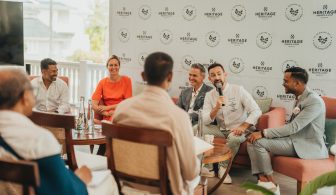

Le théâtre mauricien en créole continue de puiser dans les traditions locales pour interroger la société contemporaine. C’est dans cette filiation que s’inscrit Zagaferger Digizefgef, nouvelle création portée par Immedia, dont le directeur, Rama Poonoosamy, a présenté les grandes lignes lors d’une conférence de presse. Au-delà du divertissement, la pièce revendique une ambition : faire revivre des expressions et des pratiques culturelles qui risquent de tomber dans l’oubli.
Rappelant l’histoire du théâtre à Maurice, Rama Poonoosamy a souligné le rôle joué par des auteurs comme Dev Virahsawmy et Henri Favory, qui ont contribué à donner au créole mauricien sa place sur les planches. Lui-même engagé de longue date dans cette démarche, le directeur d’Immedia poursuit ce travail de promotion de l’écriture théâtrale locale, notamment à travers le concours Dev Virahsawmy, consacré aux textes en créole.
La dernière édition a récompensé Madaya Condeah, également connu sous le surnom de Baby Condeah, pour Zagaferger Digizefgef. Installé à Paris, l’auteur signe avec cette œuvre une satire ancrée dans la réalité mauricienne, qui s’inscrit dans la tradition des contes animaliers. Le premier prix, attribué à l’unanimité du jury, distingue ainsi un texte qui conjugue héritage culturel et regard critique sur la société.
Une langue codée à redécouvrir
Le titre renvoie au langage dit « Madame Céré », une forme de langage codé autrefois employée à Maurice, notamment au sein de certaines familles. Cette manière de communiquer permettait aux adultes d’échanger sans être compris des enfants ou des personnes non initiées. Si cette pratique reste familière à certaines générations, elle est aujourd’hui moins connue des plus jeunes.
C’est précisément cette mémoire linguistique que la pièce cherche à réveiller. En remettant en circulation des expressions et des codes de communication d’un autre temps, elle propose de renouer avec une dimension singulière de la culture mauricienne. La démarche n’est pas seulement patrimoniale : elle invite aussi à réfléchir à la façon dont les traditions évoluent, se transmettent ou disparaissent.
Autre source d’inspiration revendiquée, la chanson Kisa la Vol du groupe réunionnais Ziskakan. Ce point de départ musical nourrit un univers théâtral où les personnages animaliers servent de miroir à la société humaine. La satire permet ainsi d’aborder les comportements et les rapports de pouvoir sans renoncer à l’humour ni à la dimension populaire du spectacle.
Une mise en scène de Stanley Harmon
La réalisation a été confiée à Stanley Harmon, artiste aux multiples facettes, également connu pour son travail dans les arts visuels et la bande dessinée en créole mauricien. Il dirige une distribution qui réunit des comédiens confirmés et de jeunes talents : Adrien Beaugendre, Sylvain Polydor, Priyanka Soodhoo, Manuel Quatre Bornes, Stanley Harmon, Axel Manna et Mathieu Beesela. Les costumes et le décor sont signés Pamela Vencatasamy.
-
 Ajai Daby

En défendant une création originale en créole, Immedia poursuit un engagement qui dépasse la seule programmation théâtrale. Il s’agit de maintenir vivante une expression artistique intimement liée à l’identité de l’île, tout en lui donnant les moyens de parler aux nouvelles générations. La transmission passe ici par la scène, le jeu et la redécouverte d’un langage qui appartient à la mémoire collective.
La production bénéficie du soutien de plusieurs partenaires, parmi lesquels les groupes CIEL, Mon Loisir, Currimjee et Eclosia, la SBM et Toyota Mauritius.
Zagaferger Digizefgef sera présentée lors d’une soirée de gala le jeudi 19 novembre, puis le samedi 21 novembre à 19 h 30 et le dimanche 22 novembre à 14 h 30, au théâtre Serge Constantin, à Vacoas.
“Zagaferger Digizefgef”: Theatre Brings Forgotten Mauritian Traditions Back to Life
Mauritian Creole theatre continues to draw on local traditions to explore contemporary society. Zagaferger Digizefgef, a new production by Immedia, follows in this tradition. At a press conference, the organisation’s director, Rama Poonoosamy, outlined the project and its ambitions. Beyond entertainment, the play seeks to bring back expressions and cultural practices that risk slipping into oblivion.
Reflecting on the history of theatre in Mauritius, Rama Poonoosamy highlighted the contribution of writers such as Dev Virahsawmy and Henri Favory, who helped establish Mauritian Creole as a language of the stage. Having long been committed to this cause himself, the head of Immedia continues to promote local playwriting, notably through the Dev Virahsawmy competition, which recognises original works written in Creole.
The latest edition awarded first prize to Madaya Condeah, also known as Baby Condeah, for Zagaferger Digizefgef. Based in Paris, the writer has crafted an animal satire rooted in Mauritian life and drawing on the tradition of animal fables. Unanimously selected by the jury, the winning play brings together cultural heritage and a critical perspective on society.
Rediscovering a coded language
The title refers to the language known as “Madame Céré”, a form of coded speech once used in Mauritius, particularly within certain families. It allowed adults to communicate without being understood by children or those unfamiliar with the code. While the practice remains familiar to some generations, it is less widely known among younger Mauritians.
It is precisely this linguistic heritage that the play seeks to revive. By bringing expressions and communication codes from another era back into circulation, the production offers an opportunity to reconnect with a distinctive aspect of Mauritian culture. Its purpose goes beyond preserving the past: it also invites audiences to consider how traditions evolve, are passed down or gradually disappear.
Another acknowledged source of inspiration is Kisa la Vol, a song by Réunion Island group Ziskakan. This musical starting point informs a theatrical world in which animal characters become a mirror for human society. Through satire, the play explores behaviour and power dynamics while retaining the humour and popular appeal of the genre.
Directed by Stanley Harmon
The production is directed by Stanley Harmon, a multidisciplinary artist also known for his work in visual arts and Mauritian Creole comics. He leads a cast bringing together established performers and younger talents: Adrien Beaugendre, Sylvain Polydor, Priyanka Soodhoo, Manuel Quatre Bornes, Stanley Harmon, Axel Manna and Mathieu Beesela. Costumes and set design are by Pamela Vencatasamy.
By championing an original play in Mauritian Creole, Immedia continues a commitment that extends beyond its theatre programme. The aim is to keep alive an artistic expression closely connected to the island’s identity while ensuring that it speaks to younger generations. Here, transmission takes place through performance, acting and the rediscovery of a language that forms part of the collective memory.
The production is supported by several partners, including the CIEL, Mon Loisir, Currimjee and Eclosia groups, SBM and Toyota Mauritius.
Zagaferger Digizefgef will open with a gala evening on Thursday 19 November, followed by performances on Saturday 21 November at 7.30 pm and Sunday 22 November at 2.30 pm, at the Serge Constantin Theatre in Vacoas.