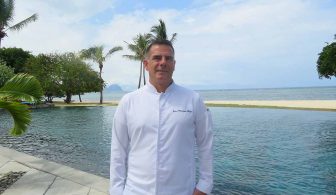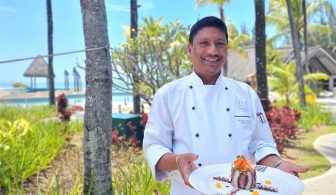


Il y a, dans la cuisine de Stephano Gracieuse, quelque chose qui ressemble à une conversation entre les générations. D’un côté, les goûts familiers, ceux du manioc, du gâteau piment, du chutney de coco ou des légumes longtemps associés aux tables familiales mauriciennes. De l’autre, le geste du chef, qui transforme, déconstruit, allège et recompose.
À La Table du Château, au Domaine de Labourdonnais, Stephano Gracieuse poursuit depuis 2012 un parcours construit essentiellement sur le terrain, au fil des rencontres, des brigades et des expériences. Mais derrière la maîtrise technique, c’est surtout une certaine idée de la cuisine qui s’est affirmée : respecter la mémoire d’un produit tout en lui offrant une nouvelle lecture.
« La cuisine, c’est un peu comme le théâtre. Chaque jour est différent. On apprend, on improvise, on crée. »
Une philosophie qui résume assez bien son approche. Car pour lui, la cuisine ne peut jamais être figée. Elle se nourrit de curiosité, d’apprentissage et surtout de transmission.
De l’apprentissage à la confiance
Stephano entre en cuisine à 17 ans, encouragé par sa mère, alors employée à l’hôtel Legends, aujourd’hui LUX* Grand Gaube. Il commence au bas de l’échelle et gravit progressivement les différents échelons de la brigade. Une expérience qui lui apprend autant la discipline du métier que l’importance du respect et de la motivation.
Parmi les rencontres qui ont marqué son parcours, celle d’Elena Sakhir occupe une place particulière. Elle est l’une des premières à lui transmettre cette envie de faire de la cuisine son métier. Puis vient Fabio De Poli, rencontré au fil de ses premières années dans l’hôtellerie et retrouvé en 2012 lorsqu’il rejoint La Table du Château.
-
 Ajai Daby

Avec Fabio, une autre étape commence : celle de la confiance. « Il m’a laissé la direction de la cuisine », raconte Stephano. Une responsabilité qui lui permet de développer sa propre identité, mais aussi de partir en France, en Normandie, pour un stage qui enrichira encore son expérience.
À La Table du Château, il découvre également un environnement singulier. Le verger devient presque un prolongement de la cuisine. Fruits, légumes et produits du domaine nourrissent une réflexion autour du terroir et donnent au chef un terrain d’expérimentation privilégié.
Cette relation directe avec les produits explique en partie l’identité de sa cuisine. Depuis plusieurs années, La Table du Château s’est notamment attachée à travailler des ingrédients et préparations mauriciennes dans une approche plus contemporaine.
Quand la mémoire devient créativité
Le défi n’est pourtant pas de transformer pour transformer. Pour Stephano, l’essentiel est de conserver le goût qui permet au convive de reconnaître le produit ou le plat derrière la nouvelle présentation.
Le dholl puri, par exemple, peut être revisité tout en conservant ses marqueurs gustatifs. Le manioc devient une galette accompagnée d’avocat. Le gâteau piment se retrouve associé à une mousse de courgette et de coriandre. Le thon mi-cuit dialogue avec un chutney de coco traditionnel. Même les patates chinoises, préparées en confit, trouvent une nouvelle expression aux côtés d’un tartare de bœuf.
Le geste est contemporain, mais la mémoire reste intacte.
Cette volonté de faire redécouvrir les produits du patrimoine culinaire mauricien constitue aujourd’hui l’une des signatures de Stephano. Il aime provoquer cette petite surprise qui pousse le client à se demander ce qu’il vient de goûter, avant de reconnaître, parfois avec émotion, une saveur familière.
À l’heure où La Table du Château ouvre un nouveau chapitre avec son positionnement bistronomique, le chef y voit surtout « un bon challenge ». Une nouvelle cuisine, un nouveau concept, mais aussi la possibilité de poursuivre une histoire commencée il y a plus d’une décennie.
Et lorsqu’on lui demande quel plat pourrait raconter son propre parcours, la réponse vient naturellement : un poisson déglacé à la vanille. Un bon babone ou un vieux rouge, un bouillon de poisson infusé à la vanille, un peu de beurre.
Comme un résumé de sa cuisine : le produit, la mémoire, le terroir et ce supplément de créativité qui transforme un souvenir en émotion.
Stephano Gracieuse : reimagining flavour without losing the memory
There is something in Stephano Gracieuse’s cooking that feels like a conversation between generations. On one side are familiar flavours — manioc, chilli cakes, coconut chutney and vegetables long associated with Mauritian family tables. On the other is the chef’s hand, transforming, deconstructing, lightening and recomposing them.
At La Table du Château, at Domaine de Labourdonnais, Stephano Gracieuse has been shaping his culinary journey since 2012, largely through hands-on experience, encounters, kitchen brigades and constant learning. Yet behind the technical mastery lies a clear philosophy: to honour the memory of an ingredient while giving it a new interpretation.
“Cooking is a bit like theatre. Every day is different. We learn, we improvise, we create.”
It is a sentence that neatly captures his approach. For Stephano, cooking can never stand still. It thrives on curiosity, learning and, above all, passing knowledge on.
From learning the craft to earning trust
Stephano entered the kitchen at 17, encouraged by his mother, who was then working at Legends hotel, now LUX* Grand Gaube. He started at the bottom and gradually worked his way through the ranks of the brigade. Those years taught him not only the discipline of the profession, but also the importance of respect and motivation.
Among the people who influenced his journey, Elena Sakhir holds a special place. She was one of the first to encourage him to see cooking as more than a job — as a profession worth pursuing. Then came Fabio De Poli, whom Stephano had encountered during his early years in hospitality and with whom he reunited in 2012 when he joined La Table du Château.
With Fabio came another defining step: trust. “He gave me responsibility for the kitchen,” Stephano recalls. That confidence allowed him to develop his own identity, while a training experience in Normandy, France, further broadened his culinary horizons.
orchard became almost an extension of the kitchen. Fruits, vegetables and produce from the grounds offered the chef a privileged space for experimentation and strengthened his connection with the land.
That direct relationship with ingredients is central to his culinary identity. For years, La Table du Château has explored Mauritian ingredients and dishes through a more contemporary lens.
When memory becomes creativity
The challenge, however, is not to transform simply for the sake of transformation. For Stephano, what matters is preserving the flavour that allows diners to recognise the ingredient or dish beneath its new presentation.
Dholl puri, for instance, can be reinterpreted while retaining its essential flavours. Manioc becomes a delicate galette paired with avocado. Gâteau piment is presented alongside a courgette and coriander mousse. Seared tuna meets a traditional coconut chutney. Even Chinese potatoes are given a new expression as a confit served with beef tartare.
The gesture may be contemporary, but the memory remains intact.
This desire to encourage diners to rediscover Mauritian ingredients and culinary heritage has become one of Stephano’s signatures. He enjoys creating that moment of curiosity when guests wonder what they have just tasted — before suddenly recognising a familiar flavour, sometimes with a touch of emotion.
As La Table du Château enters a new chapter with its bistronomic positioning, the chef sees it above all as “a good challenge”. A new cuisine, a new concept, but also an opportunity to continue a story that began more than a decade ago.
And when asked which dish could tell his own story, the answer comes naturally: fish deglazed with vanilla. A local fish such as babone or vieux rouge, a fish stock infused with vanilla and a touch of butter.
A fitting summary of his cuisine: the ingredient, the memory, the terroir — and that extra spark of creativity that turns a familiar taste into an emotion.